Author Guidelines


Submission & Manuscript Style

Author Guidelines

Advances in Educational Innovation (AEI)

Comprehensive instructions for manuscript preparation, ethical compliance, formatting, and online submission through OJS.

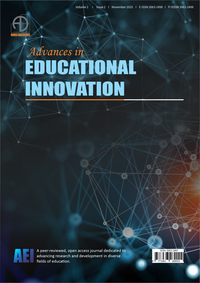
AEI Cover

General Scope and Article Types

Advances in Educational Innovation (AEI) publishes scholarly works that contribute to the advancement of educational knowledge, instructional innovation, pedagogical development, curriculum improvement, inclusive education, educational technology, and interdisciplinary education research. Manuscripts submitted to AEI must be original, unpublished, and not currently under review by another journal.

Articles may be written in English or Indonesian. However, manuscripts written in English are strongly encouraged to increase international readability, discoverability, and academic visibility.

1. Empirical Research Quantitative, qualitative, mixed-method, experimental, classroom-based, or field-based studies.
2. Conceptual Papers Current educational thinking and theoretical contributions. Published by invitation only.
3. Book Reviews Critical reviews of relevant academic books in education. Published by invitation only.
4. Obituaries Scholarly tributes to influential figures in education. Published by invitation only.

Articles must not have been presented at more than one conference or seminar. If a manuscript has been presented at more than one conference, the lead author is not allowed to submit the same article to AEI unless the editorial office provides specific approval based on originality and publication ethics assessment.

Mandatory Submission Requirements

Before submitting through OJS, authors are required to prepare the manuscript carefully and ensure that all submission files comply with the journal’s academic, ethical, and technical standards.

1. Blind Manuscript Main article text without author names, affiliations, email addresses, acknowledgements, or other identity markers.
2. Title Page Complete author names, affiliations, corresponding author details, and ORCID IDs where available.
3. Cover Letter Letter to the Editor explaining originality, contribution, novelty, and manuscript suitability for AEI.
4. Plagiarism Report Similarity report may be required by the editorial team. The acceptable similarity threshold is maximum 12%.
5. Ethics Declaration Declaration of originality, conflict of interest, authorship responsibility, and ethical compliance when applicable.
File Format
Microsoft Word (.doc/.docx)
Language
English or Indonesian
Review Type
Double-Blind Peer Review
Similarity Limit
Maximum 12%

Empirical Article Structure

 
Article Title

The article title must be clear, attractive, specific, and concise. The maximum length is 12 words. Use Times New Roman, 14 pt.

 
Author Name and Affiliation

Author names should follow the format: 1Name, 2Name, and so on, using Times New Roman, 12 pt. Affiliation should follow the format: Department, Faculty, University, Region/City, Country, using Times New Roman, 11 pt.

 
Abstract

The abstract must be written in a concise and structured manner, with a maximum of 200 words, using Times New Roman, 10 pt. It should include: Objective, Method, Findings, Novelty, and Practical and Theoretical Implications.

 
1. Introduction

The introduction must consist of 5 paragraphs: phenomenon, recent issues, main theory idea, urgency and novelty, and research objectives and benefits. The introduction should not exceed 1 page or 1,500 words. Use Times New Roman, 11 pt.

 
2. Critical Review / Theory and Hypothesis

This section should synthesize theories and previous studies to justify the hypotheses. Avoid simply listing prior studies. Authors should directly discuss the theoretical logic of each variable and present hypotheses clearly, for example: H1: Your hypothesis and H2: Your hypothesis. Use Times New Roman, 11 pt.

 
3. Research Method

The method section should explain the research design, sample or participants, instruments, variables, measurement formulas where applicable, and step-by-step data analysis procedures. The description must be detailed enough to support reproducibility.

 
4. Results and Discussion

Results should be presented clearly and interpreted in paragraphs. Authors should not merely repeat table contents but explain their meaning. The discussion must connect findings with relevant theories, previous studies, and educational implications. References should be managed using Mendeley Desktop or another reliable reference management tool.

 
5. Conclusion

The conclusion must summarize the main findings, theoretical implications, practical implications, limitations, and recommendations for future research in one paragraph, with a maximum length of 200 words.

Typography & Layout

  • Body Font: Times New Roman, 11 pt.
  • Article Title: Times New Roman, 14 pt.
  • Author Name: Times New Roman, 12 pt.
  • Affiliation: Times New Roman, 11 pt.
  • Abstract: Times New Roman, 10 pt.
  • Spacing: Single spacing.
  • Minimum Length: 12 full pages for qualitative, quantitative, and mixed-method articles.

Tables & Figures

  • Tables and figures must be placed close to the relevant explanation in the text.
  • Tables must not use vertical lines.
  • Tables should be centered on the page.
  • The source of the table must be placed below the table and center aligned.
  • Figures must be clear, readable, and relevant to the discussion.

Reference Management

References must be managed using a reference management application, preferably Mendeley. AEI requires authors to use APA Style 7th Edition consistently in both in-text citations and the reference list.

Reference Requirements:
  • Use recent and relevant scholarly references.
  • Prioritize journal articles, proceedings, books, and reputable academic sources.
  • Ensure that all references cited in the text appear in the reference list and vice versa.
  • Use APA 7th Edition format consistently.

Plagiarism, Originality, and Publication Ethics

All manuscripts submitted to AEI must be original and must not be under review or published elsewhere. After completing the manuscript, authors should ensure that the article meets ethical standards and does not contain plagiarism. The acceptable similarity limit is maximum 12%.

The editorial management team may conduct a plagiarism check using Turnitin, PlagScan, or other similarity detection tools. Authors may be requested to revise the manuscript if the similarity score exceeds the journal’s acceptable threshold. Authors are expected to comply with all editorial instructions related to originality, citation accuracy, authorship, and research ethics.

Each submitted article will be reviewed using a double-blind peer review process by at least two reviewers. When necessary, the editors may correct spelling, grammar, and formatting without changing the substantive meaning of the article.

Step-by-Step Submission Guide

1

Prepare Your Manuscript Files

Prepare the manuscript according to AEI formatting and ethical requirements before starting the OJS submission process.

  • Blind Manuscript
  • Title Page
  • Cover Letter
  • Ethics Declaration, if required
  • Plagiarism or similarity report, if required by the editorial office
2

Register or Log In to OJS

Authors must create an account or log in to the AEI OJS platform before submitting a manuscript.

Important registration fields:
• Full name and active email address
• Institutional affiliation
• Country
• ORCID iD, where available
• Agreement to the privacy statement
3

Start a New Submission

After logging in, click “New Submission”. Select the manuscript language, confirm submission requirements, and proceed to the upload stage.

4

Upload Submission Files

Upload each file using the appropriate article component in OJS.

File Recommended Component
Blind Manuscript Article Text
Title Page Supplementary File / Title Page
Cover Letter Supplementary File
Ethics Declaration Supplementary File
Plagiarism Report Plagiarism Report / Supplementary File

Repeat the upload process until all required files are uploaded, then click “Save and Continue.”

5

Enter Metadata

  • Title: Enter the manuscript title accurately.
  • Abstract: Paste the structured abstract.
  • Contributors: Add all authors and co-authors with complete affiliations.
  • ORCID: Add ORCID iD where available.
  • Keywords: Add relevant keywords one by one.
  • References: Paste the reference list in APA 7th Edition format if required by the system.
6

Confirm and Finish Submission

Review all submission data carefully. If everything is correct, click “Finish Submission.” The submission will not be received by the editorial office until this final confirmation step is completed.

Editorial Note

These guidelines are designed to assist authors in preparing and submitting articles to Advances in Educational Innovation (AEI). Authors are encouraged to follow all formatting, ethical, and submission requirements carefully to support a smooth editorial and peer-review process. Thank you for your contribution to advancing knowledge and innovation in education.

© 2026 Advances in Educational Innovation (AEI). Published by Inovasi Analisis Data.

Editor-in-Chief: Dr. Philip Abayomi Olorunfemi