About the Journal


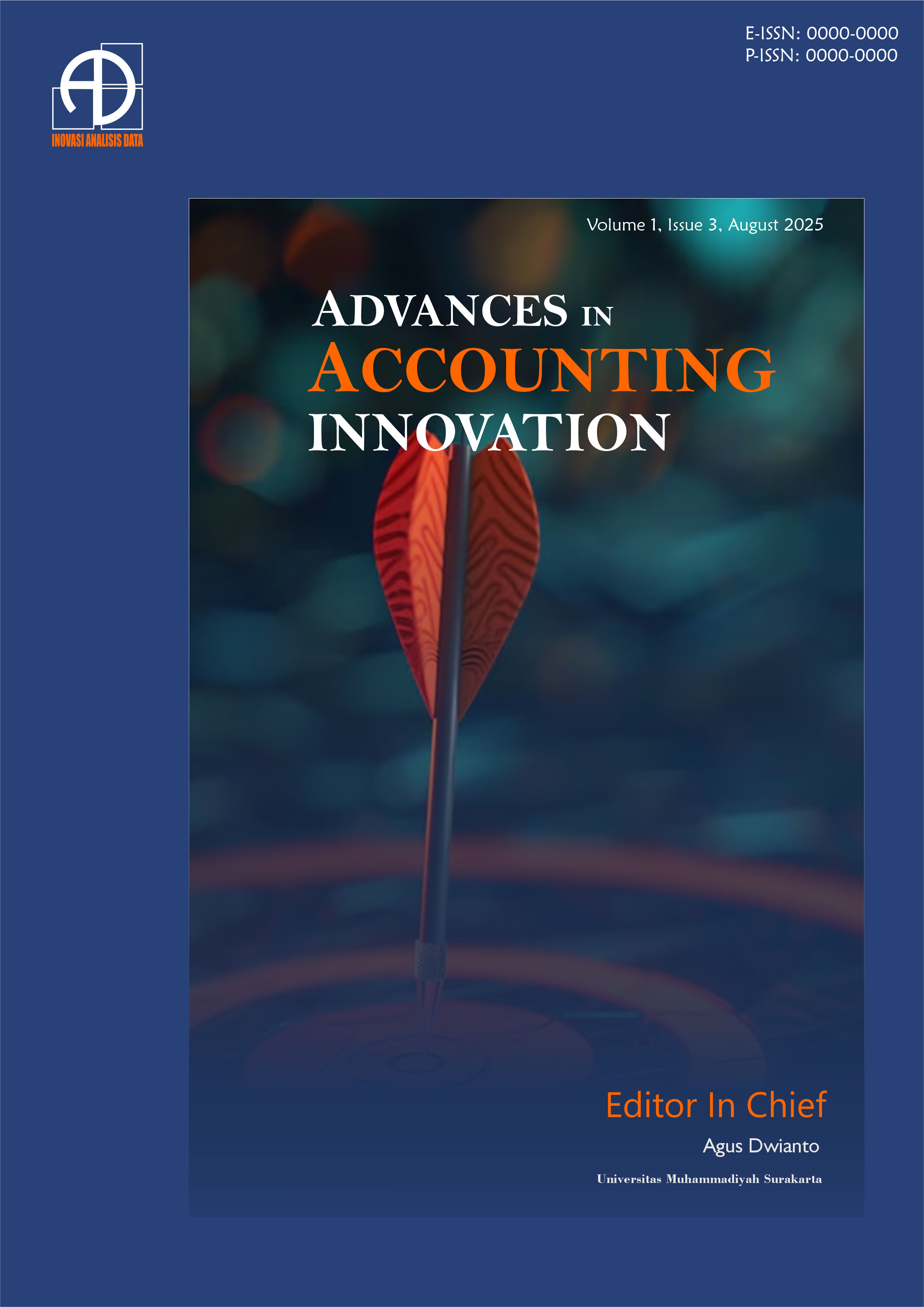
AAI Journal Cover

Advances in Accounting Innovation

Advances in Accounting Innovation (AAI) is a peer-reviewed scholarly journal dedicated to advancing research in accounting innovation, financial reporting, auditing, taxation, accounting information systems, sustainability accounting, public sector accounting, and contemporary accounting practices.

Journal Information

Journal Title Advances in Accounting Innovation
Initials AAI
Editor-in-Chief Agus Dwianto, S.E., M.Ak. (Asist. Prof.)
Publication Frequency Biannually, February and August
E-ISSN 3063-4792 (Online - Electronic)
P-ISSN 3063-3834 (Print Media)
DOI Prefix 10.69725
ORCID 0009-0002-8381-2532
Publisher Inovasi Analisis Data
Accreditation In Process SINTA
Data Access Open Access Gold
Peer Review Model Double-blind peer review

Focus and Scope

Advances in Accounting Innovation (AAI) publishes original research articles, conceptual papers, and empirical studies that contribute to the development of accounting knowledge, practice, and innovation. The journal welcomes manuscripts that demonstrate theoretical contribution, methodological rigor, practical relevance, and academic originality.

AAI particularly encourages research in the areas of financial accounting, management accounting, auditing, taxation, accounting information systems, public sector accounting, sustainability accounting, corporate governance, financial reporting, accounting technology, and digital transformation in accounting. The journal prioritizes studies that connect academic insight with professional practice, regulatory development, and institutional improvement.

Abstracting, Indexing, and Visibility

AAI is committed to improving the visibility, accessibility, and discoverability of published articles through reputable indexing services, academic databases, repositories, and scholarly discovery platforms.

Indexing Development Note: AAI is currently under submission to several indexing and abstracting bodies. The journal continues to strengthen its editorial quality, publication ethics, citation performance, international visibility, and digital preservation practices as part of its long-term preparation for evaluation by recognized indexing databases. Any future inclusion in additional indexing services will be announced only after official confirmation.

Acceptance Rate and Review Timeline

Acceptance Rate ~27% Updated July 2025
Average Time to First Editorial Decision Approximately 18 days
Time from Submission to Final Decision Up to 12 weeks
Time from Acceptance to Online Publication 15–29 days

These indicators are provided to support transparency, editorial accountability, and continuous improvement in scholarly publishing practice.

Publication Quality Indicators

Initial Editorial Screening Applied to all submissions
Peer Review Model Double-blind peer review
Minimum Reviewers Two independent reviewers
Similarity and Ethics Check Required before editorial decision
Publication Format Open access with DOI assignment

These standards are maintained to ensure transparency, academic credibility, editorial responsibility, and continuous quality improvement in the journal’s publication process.

Peer Review Process

AAI applies a rigorous double-blind peer review process to ensure that each manuscript is evaluated fairly, objectively, and academically. The identities of authors and reviewers are concealed throughout the review process to minimize bias and protect the integrity of scholarly evaluation.

  1. Initial Editorial Screening: The editorial team evaluates the manuscript’s relevance to the journal scope, originality, formatting compliance, and basic scholarly quality.
  2. Similarity and Ethical Assessment: Manuscripts are reviewed for similarity, ethical compliance, authorship integrity, and adherence to publication standards.
  3. Double-Blind Peer Review: Eligible manuscripts are assigned to at least two independent reviewers with relevant expertise.
  4. Editorial Decision: Decisions are made based on reviewer recommendations, editorial judgment, originality, methodological soundness, theoretical contribution, and practical relevance.
  5. Revision and Quality Control: Authors may be required to revise their manuscripts before final acceptance, copyediting, layout editing, and online publication.

Open Access Policy

AAI provides open access to its published content to support the dissemination and exchange of scholarly knowledge. All published articles are freely available to readers without subscription barriers. The journal follows the Open Access Gold model to ensure wider academic visibility, accessibility, and impact.

Publication Ethics and Editorial Integrity

AAI is committed to maintaining integrity, transparency, and accountability in scholarly publishing. The journal upholds ethical standards in authorship, peer review, editorial decision-making, conflict of interest disclosure, plagiarism prevention, data integrity, and correction or retraction procedures. Authors, reviewers, and editors are expected to follow responsible publication practices throughout the editorial process.

Digital Preservation

AAI is committed to the long-term accessibility, preservation, and reliability of scholarly content. The journal supports sustainable digital archiving practices to ensure that published articles remain discoverable, accessible, and preserved for future academic use. AAI continues to improve its preservation infrastructure in accordance with international scholarly publishing standards.

Editorial Philosophy

AAI values academic excellence, methodological rigor, professional relevance, and innovation in accounting research. The journal’s primary commitment is to publish scholarly work that advances accounting knowledge, addresses practical challenges, and contributes meaningfully to accounting practice, regulation, governance, and institutional development. AAI encourages manuscripts that demonstrate originality, analytical depth, ethical integrity, and relevance to academic, professional, and policy communities.